Adult foster care in Minnesota: the option most families never hear about
Adult foster care is a licensed residential home providing housing, meals and 24-hour support to a small number of adults. Minnesota licenses it through the Department of Human Services — not the Department of Health — under Minn. Rules 9555.5050 to 9555.6265, with county agencies closely involved.
 Illustration
What adult foster care actually is
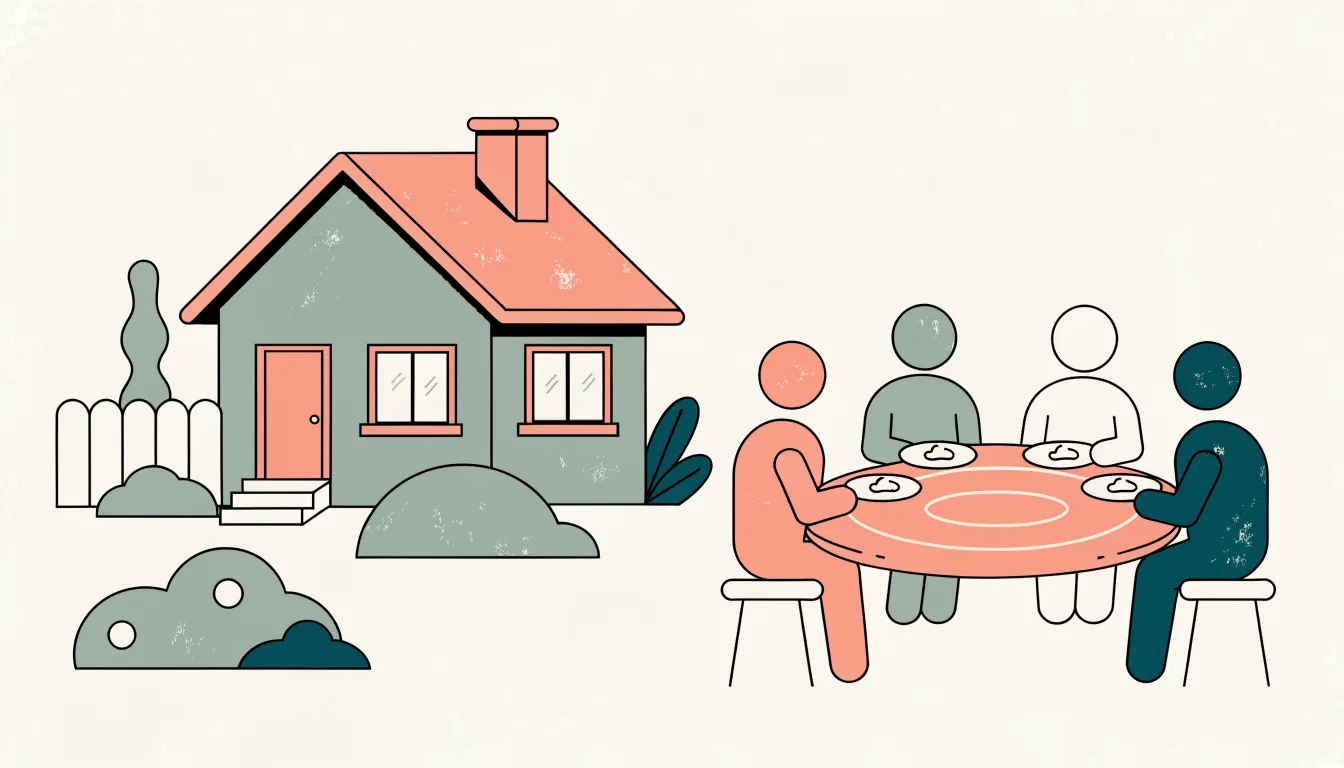
Adult foster care is care delivered in a house. Not a campus, not a wing, not a building with a reception desk — an ordinary residential home on an ordinary street, licensed to provide housing, meals, supervision and support to a small number of adults who cannot safely live alone.
For some families it is exactly the right answer and they never hear it offered. A parent with dementia who becomes agitated in a large building may settle in a house with four other people and the same two caregivers every day. An adult under 65 with a brain injury or a developmental disability may need a level of daily structure that no assisted living apartment is designed to provide. The trade-off is the opposite of what most people expect from senior care: less choice of amenities, far more continuity of staff.
It also sits in a different regulatory world from everything else in Minnesota senior care. Adult foster care is licensed by the Department of Human Services, under Minnesota Rules parts 9555.5050 to 9555.6265, with local agencies carrying much of the practical work — the rule chapter itself assigns foster home development and the orientation and training of license holders to the local agency. Sources: MN House Research, "Regulation of Health and Human Services Residential Facilities" (Dec 2021) and Minn. Rules 9555.5050–9555.6265 — adult foster care services and licensure of adult foster homes.
Family adult foster care and corporate adult foster care
Minnesota recognises two forms, and the difference is not cosmetic. In family adult foster care, the license holder lives in the home — it is their own primary residence, and residents live in it with them. In corporate adult foster care, the license is held by an organisation and staff work shifts in a house that nobody owns as their own home. A moratorium on new corporate adult foster care licenses is in effect, with exceptions. Source: MN House Research, "Regulation of Health and Human Services Residential Facilities" (Dec 2021).
| Family adult foster care | Corporate adult foster care | |
|---|---|---|
| Who holds the license | An individual or a couple | An organisation |
| Where the care happens | The license holder’s own primary residence | A house operated by the provider |
| Who provides the care | The license holder, usually with substitute caregivers | Employed staff, typically on shifts |
| New licenses | Available | Subject to a moratorium, with exceptions |
| What that means for you | Continuity is the strength; the household is somebody’s home first | More capacity to cover complex or overnight needs; supply is constrained |
Minnesota House Research Department, "Regulation of Health and Human Services Residential Facilities," December 2021. The moratorium and its exceptions are set by statute and change — confirm the current position with the county or DHS.
How many people live in one home?
This is the question every family asks, and it is the one we are not going to answer with a single number. The rule chapter contains a capacity provision, but it is expressly subject to exceptions elsewhere in statute, and community residential settings — which look similar from the kerb — are licensed under a different framework entirely. Published summaries that state a flat "four, or five with a variance" are repeating a rule of thumb, not reading a license.
The number that governs a particular home is the licensed capacity printed on that home’s own DHS license. Ask for it, and check it in the DHS licensing lookup. That takes two minutes and is correct; the rule of thumb takes no time and may not be.
Who licenses what in Minnesota — the map families never get
Almost every confusing conversation about Minnesota care options comes back to this table. Two different state agencies license residential care, under different chapters, with different inspection regimes and different public lookups. Knowing which one you are dealing with tells you where to check a license, who to complain to, and what the setting is legally allowed to do.
| Setting | Licensed by | Under | Where to verify |
|---|---|---|---|
| Adult foster care home | Department of Human Services, with county involvement | Minn. Rules 9555.5050–9555.6265 | DHS licensing lookup |
| Community residential setting | Department of Human Services | A separate DHS licensing framework | DHS licensing lookup |
| Assisted living facility, and assisted living facility with dementia care | Department of Health | Minn. Stat. ch. 144G, since 1 August 2021 | MDH verify a license |
| Nursing facility | Department of Health, plus federal certification where it serves Medical Assistance | Minn. Stat. ch. 144A | MDH, plus Medicare Care Compare |
| Home care provider (basic or comprehensive) | Department of Health | Minn. Stat. ch. 144A home care provisions | MDH health care provider directory |
Compiled from MN House Research (December 2021), MDH licensure pages, and the Minnesota Rules and Statutes cited throughout this guide.
How much of this care exists in Minnesota
The most recent counts we could trace to a primary source are five years old, and we are labelling them as such rather than quietly presenting them as current. As of the December 2021 House Research review, Minnesota had 1,261 adult foster care homes with a combined capacity of 3,336, and 3,957 community residential settings with a combined capacity of 14,237. Source: MN House Research, "Regulation of Health and Human Services Residential Facilities" (Dec 2021).
Two things are worth taking from those 2021 figures even though they are dated. First, the average adult foster care home held fewer than three people — this is genuinely small-scale care. Second, community residential settings are the much larger category by capacity, which is why families searching for "adult foster care" often end up looking at homes that are technically something else.
How adult foster care gets paid for
Most adult foster care in Minnesota is funded rather than purchased. The usual structure has two halves, and confusing them is the single most common budgeting mistake families make.
- The services half — supervision, personal care, support with daily living — is normally paid by a Medicaid waiver. Which waiver depends on the person: the Elderly Waiver for people 65 and over, and CADI, DD or BI for adults under 65 depending on the nature of the disability.
- The room and board half — rent and food — is not paid by the waiver. It comes from the resident’s own income, and for some people from the Housing Support program.
DHS states the services-versus-room-and-board split plainly in its Elderly Waiver material: "the Elderly Waiver only pays for your services," and "you are responsible for paying the costs of room and board." It also notes that some people may be eligible for the Housing Support program, which pays for room and board, while adding that not everyone who qualifies for the Elderly Waiver will qualify for Housing Support. Source: Minnesota DHS, "Elderly Waiver services in assisted living" (DHS-7935-ENG, 7-2024).
Eligibility runs through an assessment, not through the home
Waiver funding is not something a foster home can grant. It follows an assessment carried out by the county or tribal lead agency, which determines the level of need and therefore what the waiver will pay. For the Elderly Waiver, DHS states the needs assessment is free, takes about two hours, and should occur within 20 calendar days of the request, while the financial side of the application may take 45 days or longer. Source: Minnesota DHS, "Elderly Waiver services in assisted living" (DHS-7935-ENG, 7-2024). Our Elderly Waiver guide walks through that process in full.
Adult foster care compared with the alternatives
Families rarely choose adult foster care in isolation. They choose it against assisted living, against a nursing home, or against staying at home with paid help. Here is how the four compare on the dimensions that actually drive the decision.
| Adult foster care | Assisted living | Nursing facility | Care at home | |
|---|---|---|---|---|
| Scale | A house with a small number of residents | Apartments in a purpose-built or converted building | Institutional, typically shared or private rooms | One household |
| Licensed by | DHS, with county involvement | MDH, ch. 144G | MDH, ch. 144A | MDH licenses the agency, not the home |
| Clinical ceiling | Support and supervision; skilled care is brought in | Services disclosed in the contract and uniform checklist | 24-hour skilled nursing | Whatever the agency is licensed to provide |
| Typical funding | Waiver for services, own income or Housing Support for room and board | Private pay, or the Elderly Waiver for services only | Largely Medical Assistance for long-stay residents | Private pay, waiver, or Medical Assistance rates |
| Where openings are found | County case managers, and directly with the home | Directly with the community | Hospital discharge planning and directly | Directly with agencies |
Compiled from the Minnesota licensing sources cited in this guide. "Clinical ceiling" means the point at which a setting can no longer meet a person’s needs — the question worth asking before a move, not after.
The cost comparison is where adult foster care often surprises people, because Minnesota’s in-home care costs are unusually high. In Genworth’s 2024 survey, Minnesota ranked 4th in the nation for home health aide costs and 5th for homemaker services, while ranking 29th for assisted living. Source: Genworth, 2024 Cost of Care Survey — Minnesota. We break that down in what assisted living actually costs in Minnesota and the home care guide.
How openings actually work, and what to ask
Adult foster care does not have a marketing funnel. Homes are small, most do not advertise, and a single opening can be filled through a case manager before it is ever posted anywhere. Two routes run in parallel, and you should use both.
- Through the lead agency. If the person is on a waiver or being assessed for one, the county or tribal case manager is the route that matters. Placement coordination is part of the job, and the rule chapter gives local agencies a formal role in developing foster homes.
- Directly. Nothing stops you contacting licensed homes yourself, asking about openings, and visiting. Homes that would never appear in a search result will answer a phone.
Questions to ask a Minnesota adult foster care home
- What is the licensed capacity on your DHS license, and how many people live here now?
- Is this a family adult foster care license with the license holder living in the home, or a corporate license with shift staff?
- Who provides care overnight, and who covers when the usual caregiver is away or ill?
- Which waivers do you accept, and are you enrolled to bill them?
- What is the room and board charge, what does it cover, and how is it billed separately from waiver-funded services?
- How do you handle medications, and who is qualified to administer them?
- What would make you decide you can no longer meet someone’s needs, and what happens then?
- How do you handle a resident whose needs increase — do skilled services come in, or does the person move?
- May I see the individual resident placement agreement you would use?
- Can I visit at a normal time of day, unannounced, before deciding?
Verify anything you are told. Adult foster care licenses are checked in the DHS licensing lookup, not the MDH tools most families are pointed to. Our guide to checking a Minnesota care provider’s license shows which lookup to use for which setting, and every listing on RightCare MN says plainly what license data we hold for that provider, with the number itself shown on verified listings.
To start looking: browse licensed adult foster care homes across Minnesota, or narrow by place — Minneapolis, Hennepin County, or anywhere else in the state. If the person needing care is under 65, disability services is usually the neighbouring category worth searching at the same time.
Questions people ask
What is adult foster care in Minnesota?
A licensed residential home providing housing, meals, supervision and support to a small number of adults who cannot live independently. It is licensed by the Minnesota Department of Human Services under Minnesota Rules 9555.5050 to 9555.6265, with county agencies involved in developing and overseeing homes, and it comes in two forms: family adult foster care and corporate adult foster care.
Source: MN House Research, "Regulation of Health and Human Services Residential Facilities" (Dec 2021)
Who licenses adult foster care in Minnesota — MDH or DHS?
The Department of Human Services, not the Department of Health. That is why adult foster care homes do not appear in the MDH facility license lookup that families are usually pointed to. Assisted living, nursing facilities and home care agencies are MDH; adult foster care and community residential settings are DHS, and DHS runs its own licensing lookup.
Source: MN House Research, "Regulation of Health and Human Services Residential Facilities" (Dec 2021)
How many residents can a Minnesota adult foster care home have?
The number that governs a specific home is the licensed capacity printed on that home’s own DHS license, and you can check it in the DHS licensing lookup. The rule chapter contains a capacity provision, but it is subject to exceptions in statute and community residential settings are licensed under a separate framework, so we do not publish a single figure.
Source: Minn. Rules 9555.5050–9555.6265 — adult foster care services and licensure of adult foster homes
What is the difference between family and corporate adult foster care?
In family adult foster care the license holder lives in the home — it is their own primary residence. In corporate adult foster care an organisation holds the license and staff work shifts. A moratorium on new corporate adult foster care licenses is in effect, with exceptions, which is why supply in that form is constrained.
Source: MN House Research, "Regulation of Health and Human Services Residential Facilities" (Dec 2021)
How is adult foster care paid for in Minnesota?
Usually in two halves. A Medicaid waiver — the Elderly Waiver for people 65 and over, or CADI, DD or BI for adults under 65 — pays for the services. Room and board is separate, paid from the resident’s own income or, for some people, through the Housing Support program. DHS states that the waiver pays for services and that the resident is responsible for room and board.
Source: Minnesota DHS, "Elderly Waiver services in assisted living" (DHS-7935-ENG, 7-2024)
How many adult foster care homes are there in Minnesota?
The most recent count traceable to a primary source is from December 2021: 1,261 adult foster care homes with a combined capacity of 3,336, alongside 3,957 community residential settings with a capacity of 14,237. Those figures are five years old and should be treated as a picture of scale rather than a current inventory.
Source: MN House Research, "Regulation of Health and Human Services Residential Facilities" (Dec 2021)
How do I find an adult foster care opening in Minnesota?
Two routes, used together. If the person is on a waiver or being assessed for one, the county or tribal case manager coordinates placement and usually hears about openings first. You can also contact licensed homes directly — most are small and do not advertise. Verify any home’s license in the DHS licensing lookup before visiting.
Sources
- MN House Research, "Regulation of Health and Human Services Residential Facilities" (Dec 2021)
- Minn. Rules 9555.5050–9555.6265 — adult foster care services and licensure of adult foster homes
- Minnesota DHS Licensing Information Lookup
- Minnesota DHS, "Elderly Waiver services in assisted living" (DHS-7935-ENG, 7-2024)
- Genworth, 2024 Cost of Care Survey — Minnesota
- Minnesota Department of Health — Assisted Living Licensure
- MDH — Verify a Facility License
- MN Office of Ombudsman for Long-Term Care
- Minnesota Aging Pathways (formerly the Senior LinkAge Line), 1-800-333-2433 — Minnesota Board on Aging
This guide was last checked against these sources on August 14, 2026. RightCare MN is a Minnesota care directory, not a clinical, legal, or financial adviser — this is general information, not advice about your situation. Programs, rates, and rules change; confirm anything you are relying on with the agency directly before you act on it.